The Drama Triangle in Companies: How Victims, Persecutors and Rescuers Shape Culture
Karpman's drama triangle shows how victim, persecutor and rescuer roles arise in teams, shape company culture, and how leaders can step out of the pattern.
Recurring conflicts in teams often follow a pattern: someone feels powerless, someone blames, someone steps in. This article shows how such roles turn into a company culture and how leaders can break the pattern.
At a glance
- The drama triangle (also called the victim-perpetrator-rescuer triangle or Karpman triangle) describes three roles in conflicts: victim, persecutor and rescuer.
- People switch between the roles, and this keeps the pattern alive.
- Culture is built from repeated everyday experience. What leaders notice, what they reward and how they react to mistakes become the unwritten rules.
- Acey Choy's winner's triangle describes alternatives: vulnerable, assertive and caring.
- The model is a tool for reflection. It works for self-reflection and for team conversations. It is not suitable as a label for other people.
Why organisations get stuck in the same patterns
Many problems in companies come back, even though processes, KPIs and structures were reworked long ago. The cause is often less the system than how people deal with each other when something goes wrong: Who takes responsibility, who looks for someone to blame, who steps in?
A helpful model for this is the drama triangle by the psychiatrist Stephen Karpman, often called the victim-perpetrator-rescuer triangle in everyday use. It describes three roles people fall into under pressure: victim, persecutor and rescuer. This article uses the model as a lens to understand how such roles turn into a company culture in daily work.
The model describes behaviour patterns that keep conflicts alive and make personal responsibility harder. It says nothing about a person as a whole. The central question is:
How do we get out of blame, helplessness and constant rescuing, and take responsibility together?
The three roles: victim, persecutor, rescuer
Karpman developed the model in 1968 within transactional analysis and described it in Fairy Tales and Script Drama Analysis. In the original, the second role is called Persecutor. This fits better than "perpetrator", because it refers to a behaviour in conflicts. This article therefore uses the term persecutor throughout.
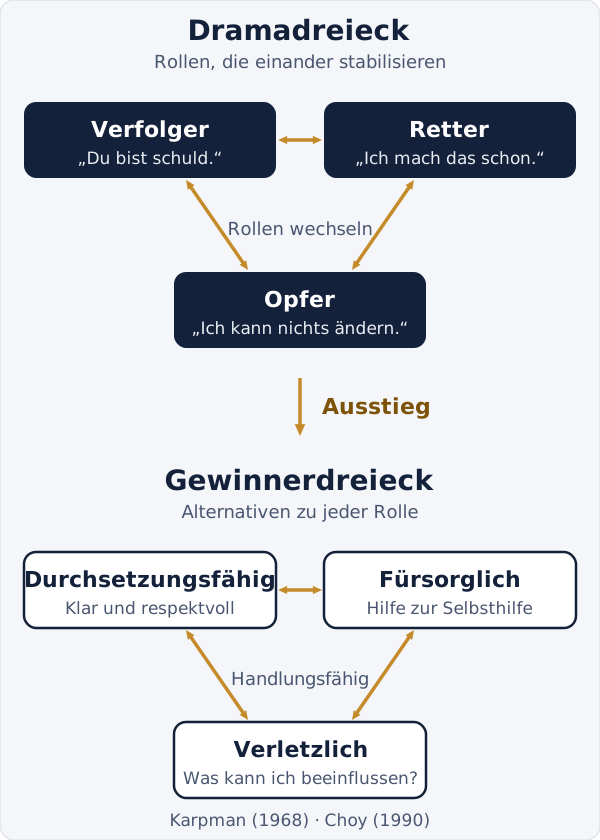
The victim: "I am powerless."
People in this role feel helpless, dependent or treated unfairly. Typical phrases are "I can't change anything anyway", "The others are blocking my success" or "I have no other choice".
The role gives short-term relief: if only others are responsible, I don't have to look at my own options. It becomes a problem when it is a permanent state in which one's own influence is always ignored.
It is important to draw a line here: people can truly be victims of violence, discrimination or unjust power relations. The model describes an inner attitude. It must never be used to make those affected responsible for the injustice they suffered.
The persecutor: "It's your fault."
The persecutor deals with problems through criticism, pressure, control and blame. Typical phrases are "If you were more competent, this would not have happened" or "I always have to check everything".
This gives a short-term feeling of control and usually makes it harder to find the real causes. Justified criticism and clear responsibilities are not persecutor behaviour. What matters is whether the communication serves the problem or devalues the person.
The rescuer: "You can't do it without me."
The rescuer role is the trickiest because society sees it as a virtue. Rescuers seem committed, helpful and responsible: they take over tasks, resolve conflicts and step in. Typical phrases are "I'd rather do it myself" or "I'll take over before anything goes wrong".
Help is valuable. It becomes a pattern when someone permanently carries responsibility that others could and should carry themselves. The psychoanalyst Wolfgang Schmidbauer described this dynamic in 1977 as the "helper syndrome".
The rescuer may end up reinforcing the very helplessness he wants to remove.
Why the pattern is so stable
The three roles depend on each other, and the people involved switch between them. An employee feels overwhelmed and expects support. His manager takes over the task and relieves him. Over time, the manager becomes overloaded and accuses him of lacking initiative. He feels treated unfairly and takes it as confirmation that he has no influence.
This creates a cycle: helplessness → rescuing → overload → blame → helplessness again. The rescuer becomes the persecutor, and the persecutor then feels like a victim. Everyone involved can be convinced they are doing the right thing, and in doing so they keep the pattern alive.
The victim stance has a parallel in research on learned helplessness, which Martin Seligman described from the 1960s onward: people who repeatedly experience that their actions have no effect stop trying, even when room to act opens up again later.
The model does not explain every conflict. It makes recurring interactions visible that otherwise pass as "bad luck" or "difficult people."
From pattern to culture: what is rewarded repeatedly becomes the rule
Culture emerges from repeated everyday experience. What happens when someone reports a mistake, makes a decision or asks for help? According to Edgar Schein, culture works on three levels: visible artifacts, stated values and basic, mostly unconscious assumptions. Managers shape the deepest level mainly through what they notice, measure and reward, and through how they react in a crisis.
Three mechanisms turn a role pattern into a culture:
- Reward. The "firefighter hero" who puts out a fire every week is praised and promoted. Those who solve problems early and quietly stay invisible. The organization learns that rescuing counts for more than prevention, and that "nothing works without me" is a virtue.
- Reaction to mistakes. Is the bearer of bad news heard or punished? The sociologist Ron Westrum distinguishes pathological, bureaucratic and generative cultures (see table).
- Stories. Teams tell each other what happened when someone disagreed or failed. New employees learn from this within weeks what is safe. Chris Argyris called the result "defensive routines": people avoid sensitive topics and also make the avoidance itself undiscussable.
| Culture type (Westrum) | Orientation | Bearers of bad news | Handling of mistakes |
|---|---|---|---|
| Pathological | Power | are punished | Search for who is to blame |
| Bureaucratic | Rules | are overlooked | Clarifying who is responsible |
| Generative | Performance and learning | are encouraged | Search for causes |
One possible reading: the pathological culture resembles an institutionalized persecutor pattern, the bureaucratic culture pushes responsibility upward and thereby encourages the victim stance, and the generative culture matches the winner's triangle (see below). This is an interpretation, not a finding by Westrum.
The roles in a company
The three roles appear at every level, usually in a typical pattern.
The manager as rescuer
A committed manager steps in when the team struggles: they make decisions, take over tasks and resolve conflicts. In the short term this works. Deadlines are met and results are delivered. In the long term the team relies on the manager, and the manager becomes a bottleneck. Then the manager complains about a lack of personal responsibility, even though their own behavior helped cause it.
Senior management as persecutor
Those who lead mainly through control and blame attribute poor results to individuals. They respond with extra reports, approvals and escalations. The organization then focuses on protecting itself instead of solving problems. Employees learn that it is safer to push decisions upward.
Employees in the victim role
People who see for a long time that others make the decisions develop resignation. Statements such as "Management decides everything anyway" or "Our suggestions are not heard" can express real structural problems. Occupational research knows this: according to Robert Karasek, the combination of high demands and little decision latitude is a particular source of strain.
Responsibility without decision-making authority is not real self-responsibility. If you expect initiative, you have to create room to act.
An everyday example
The following example is made up and serves only as an illustration.
A team leader sees in the evening that a customer quote is still unfinished. He finishes it himself because the customer is waiting. The employee learns: if I hesitate, he takes over. After a few months, everything important goes across his desk, and he says in a meeting: "Why does nobody here decide for themselves?" She thinks: "When I tried, it was reworked." The managing director sees delays and introduces an additional approval step.
Each side acts in an understandable way. Together they stabilize a pattern in which decisions keep moving further up.
Metrics do not replace a culture of trust
When results are unsatisfactory, many organizations respond with more metrics, stricter controls and more detailed reports. Metrics create transparency, but only about what is reported. If people hide mistakes out of fear of blame, even the best dashboard shows a flattering picture.
The organizational researcher Amy Edmondson found a surprising result in hospital teams: teams with a more open climate reported more errors, not fewer (Learning from Mistakes Is Easier Said Than Done, 1996). The difference lay in reporting behavior. The number of errors alone does not explain it. In a later study she showed that psychological safety is linked to learning behavior in teams (Psychological Safety and Learning Behavior in Work Teams, 1999).
Psychological safety means that employees can ask questions, voice uncertainty and raise mistakes without fearing personal put-downs. Responsibility and criticism remain. An organization that can learn needs clear responsibilities and a constructive way of handling mistakes.
Metrics show what is happening. They replace neither a sound strategy nor a responsible leadership culture.
The link to the drama triangle is an interpretation: where blame (persecutor) is a threat, staying silent (victim stance) and takeover by superiors (rescuer) are the obvious responses. Edmondson's studies do not directly prove this link.
Mobilization and personal responsibility
Pressure, blame and the image of a threat create activity in the short term. Anger is a strongly activating emotion. It increases readiness to act, directs attention to those who seem responsible and makes complex issues look simple. Employees may then work faster and with more focus on a goal.
Short-term activity is not the same as lasting motivation. Self-determination theory by Edward Deci and Richard Ryan (2000) distinguishes autonomous motivation, which comes from meaning and personal goals, from controlled motivation, which rests on pressure, fear or reward. Controlled motivation usually does not last as long and goes along with lower well-being.
People can follow a leader for three reasons: fear of consequences, outrage at a common enemy, or because they understand the purpose of the task and share the goals. These motives are not equal. Only the third holds even when the leader is not present.
Good leadership also shows in how independently people act when the leader is not there.
The way out: the winner's triangle
In 1990, the psychotherapist Acey Choy set a counter-model against the drama triangle: The Winner's Triangle. Each role gets a constructive counterpart. Choy calls the three positions vulnerable, assertive and caring.
| Drama triangle | Winner's position (Choy) | Guiding question |
|---|---|---|
| Victim: "I am helpless." | Vulnerable: acknowledge your own needs and limits, look for ways to act | What can I influence myself under these circumstances? |
| Persecutor: "It's your fault." | Assertive: state limits and expectations clearly, respectfully and responsibly | How do I ask for responsibility without attacking the person? |
| Rescuer: "I'll solve your problem." | Caring: support others without taking over their responsibility | How do I help in a way that makes the other person act more independently in future? |
A related version is common in business: in The Power of TED* (The Empowerment Dynamic), David Emerald replaces the victim with the creator, the persecutor with the challenger and the rescuer with the coach. Both models mean the same thing: responsibility stays where the decision lies, and support strengthens others.
How to step out of the drama triangle
Stepping out starts with noticing. It is enough to recognize your own role without judging it. Then a small step toward the matching winner position helps.
| If you see yourself as … | How you notice it | First step |
|---|---|---|
| Victim | "I can't change anything anyway," waiting for others | Write down what you can influence, even if it is small, and phrase a specific request for support. |
| Persecutor | Irritation, the search for someone to blame | Describe what you have observed and turn the accusation into a request. Ask: "What led to this?" |
| Rescuer | You take over without being asked and feel exhausted | Ask "What do you need from me?" and "What would you do?" before you take over. The task stays with the other person. |
Five questions help in the moment you notice the pattern:
- What responsibility is actually mine?
- What options for action do I have?
- Am I looking for someone to blame or for a solution?
- Am I helping, or am I permanently taking over other people's responsibility?
- Which facts do I know, and which conclusions are based mainly on emotions?
In cases of violence, bullying or abuse of power, getting out is not a task for the affected person alone. Managers, the HR department, the works council or a counselling service can help here.
Self-organization and holacracy: enabling responsibility through structure
In traditional hierarchies, decisions easily move upward and problems end up with managers. Self-organized models such as holacracy instead spread responsibility and decision-making authority across defined roles and teams, and they regulate decision processes. This can reduce dependence on individual leaders.
The results are mixed, however. Harvard Business Review evaluated the experience of Zappos (Bernstein et al., 2016, Beyond the Holacracy Hype, HBR 94, issue 7/8) and separates exaggerated promises from real potential. According to this, whether the model fits depends on the context of the organization. Structures do not replace the personal maturity of the people involved.
Self-organized teams also develop informal power structures, blaming and rescuer behavior. A team can agree on roles and still hand every difficult decision to the person who "is best at it anyway."
Self-organization works when responsibility, decision-making authority and the ability to handle conflict are aligned.
What managers can do in practice
Culture changes where repeated experiences change. The overview below shows how to recognize each pattern in daily work and which countermeasure interrupts it.
| Pattern | Signal in daily work | Countermeasure |
|---|---|---|
| Rescuing | Decisions and tasks end up with the manager; "I'll just do it myself quickly" | Delegate with real decision-making authority; ask "What would you do?" instead of taking over; clarify decision rights in writing |
| Persecuting | Debriefs start with "Who did this?"; mistakes become known late or through third parties | Debriefs without blame hunting (What led to this?); talk about your own mistakes first; explicitly thank people who bring bad news |
| Victim mindset | "Management decides that anyway"; waiting for instructions | Clarify the room to act and actually leave it to the team; always answer suggestions; hand over small decisions early |
Three principles support this: decision-making authority goes together with responsibility, criticism addresses behavior and the matter at hand, and help is given in a way that eventually makes it unnecessary.
I describe how I understand self-leadership and responsibility in my leadership manifesto.
Self-assessment for leadership teams
Every "Yes" is a reason to start a conversation in the team and says nothing about individuals. For each question, choose Yes, Partly or No. The result appears immediately below the table. The answers are not saved.
| Question | Yes | Partly | No |
|---|---|---|---|
| 1. Decisions Do decisions that the team could make itself regularly end up with you? | |||
| 2. Taking over Did you recently take over a task that someone else could have solved? | |||
| 3. Debrief Do your debriefs tend to start with "Who?" rather than "What led to this?" | |||
| 4. Mistakes Do you often hear about mistakes late or from third parties? | |||
| 5. Recognition Do you mainly praise the person who puts out the most fires? | |||
| 6. Feedback Are there suggestions from the team that never got a response? |
Evaluation (number of Yes answers):
- 0 to 1 Yes: The pattern hardly shows in your team. Ask your team whether they see it the same way.
- 2 to 3 Yes: Some signs. Pick one example and discuss in the team which behavior is currently being recognized there.
- 4 to 6 Yes: Several signs. An open conversation in the leadership team about decision rights and how you handle mistakes can be a good first step.
This is a self-assessment, not a scientifically validated test.
Limits and misuse of the model
The drama triangle is a reflection model from transactional analysis. It is not a broadly validated empirical theory. It describes patterns that many people recognize, and it does not explain every conflict. The application to organizations, social media and politics in this article is also an interpretation. The cited research on psychological safety, motivation and emotions offers additional insights and does not prove the model itself.
In daily leadership, there is a second, practical danger: the model becomes a weapon. If you tell a colleague "You are in the victim role right now" or "You are a rescuer", you devalue them and make a persecutor's move yourself. The model works for self-reflection and for shared conversations about patterns.
Finally, it must never be used to play down real injustice. Complaints about overload, abuse of power or lack of a voice deserve attention and a review first, before anyone interprets them as role behavior.
The same pattern outside the company: social media and political communication
The drama triangle also explains why some public debates are so effective and so deadlocked. Many emotionally charged posts follow the same story structure: a group is wronged (victim), someone is blamed for it (persecutor), and a person or movement offers protection or a solution (rescuer). This is quick to grasp and emotionally strong. Nuanced explanations, by contrast, take time and a willingness to tolerate contradictions.
This story structure is not a feature of any particular political direction. It appears in parties of all camps, in interest groups, in the media and just as much in companies, for example when a management builds up an "opponent" in the market or in its own workforce.
The research partly supports this observation:
- Anger can influence attention and information processing. In Emotions, Partisanship, and Misperceptions, Brian Weeks examined how emotions and political attitudes relate to susceptibility to misinformation.
- Moral outrage favors the spread of misinformation, as Misinformation Exploits Outrage to Spread Online (Science, 2024) shows.
- Platform mechanisms optimized for engagement can make emotionally charged and hostile content about other groups more visible, according to a study in PNAS Nexus (2025).
This does not mean that angry people are easy to steer. Anger can just as well trigger resistance to influence and justified protest. And not every emotional message is manipulation: emotions are part of politics. It becomes a problem when enemy images are reinforced over the long term and the willingness to consider different perspectives and verifiable facts declines.
For companies, the same applies internally: if you build internal communication on forming camps and assigning blame, you risk the same conflict dynamics as in public online debates. It also cannot be proven that parties or companies deliberately act according to Karpman's model.
Frequently asked questions about the drama triangle
What is the victim-persecutor-rescuer triangle, in simple terms?
Stephen Karpman's drama triangle describes three typical roles in conflicts: The victim feels helpless, the persecutor blames others, and the rescuer takes on other people's problems. People switch between the roles, and this keeps the pattern alive. These are behavior patterns, not personality traits.
How do I know if I am in the drama triangle?
Typical signs are recurring conflicts in which people blame each other, feel helpless or constantly step in for one another. Another sign is the feeling of having the same conversations again and again without anything changing.
Why is the rescuer role a problem?
Help becomes a problem when it permanently replaces other people's own responsibility. Anyone who constantly takes over tasks and decisions encourages dependency and overloads themselves. Good support makes others more capable of acting.
How can you leave the drama triangle?
The way out starts with recognizing your own role. After that, you speak openly about needs, clarify responsibility and develop concrete options for action. Acey Choy's winner's triangle offers three points of orientation for this: vulnerable, assertive, caring. You will find first steps for each role in the section "How to get out of the drama triangle".
What does the drama triangle mean for managers?
Managers easily slip into the rescuer role when they solve all problems themselves, or into the persecutor role when they lead through control and blame. Good leadership creates clear responsibilities, real room for decisions and a way of handling mistakes that allows people to learn.
How does the drama triangle shape company culture?
What leadership repeatedly rewards or punishes becomes an unwritten rule. If rescuers are celebrated and people who report mistakes are punished, employees learn to hide problems and push decisions upward. This weakens personal responsibility, trust and teamwork.
What is the difference between the drama triangle and the winner's triangle?
The drama triangle describes problematic conflict roles, while the winner's triangle describes constructive alternatives: instead of helplessness, awareness of your own needs and options for action; instead of blame, respectful assertiveness; instead of over-rescuing, supportive behavior.
Is the drama triangle scientifically proven?
Not as a comprehensive theory. It is a recognized model for reflection in transactional analysis. For statements about leadership, psychological safety or motivation, you should also draw on empirical research.
Does self-organization prevent the drama triangle?
Not automatically. Clear roles and distributed decision-making authority can reduce dependence on individuals. But victim, persecutor and rescuer patterns also arise in self-organized teams when responsibility, the ability to handle conflict and open communication are missing.
Does the drama triangle play a role in social media and politics?
As a way of thinking, it can help you spot emotionally charged stories that feature a victim, a culprit and a rescuer. It can be applied across all parties and is not proof that anyone is manipulating on purpose.
Conclusion: culture is what gets rewarded again and again
The drama triangle shows how understandable individual reactions turn into a pattern: we feel powerless, we blame others, or we solve everything ourselves. Each reaction makes sense on its own. Together, they keep the problem alive.
For companies, this means: culture is shaped by what leadership pays attention to, what it rewards and how it reacts to mistakes. Good leadership strengthens the team's ability to act. It clarifies who may decide what, treats mistakes as a chance to learn, and so makes help unnecessary. My overall view of leadership is set out in the Leadership Manifesto.
The drama triangle helps us understand why we look for someone to blame, and how we can break out of this pattern.
Sources and further reading
The model
- Karpman, S. B. (1968). Fairy Tales and Script Drama Analysis. Transactional Analysis Bulletin, 7(26), 39–43. Original work on the drama triangle.
- Choy, A. (1990). The Winner's Triangle. Transactional Analysis Journal, 20(1), 40–46. Counter-model with the positions vulnerable, assertive and caring.
- Emerald, D. (2016). The Power of TED* (The Empowerment Dynamic), 3rd ed. Polaris Publishing. Related version for the business context.
- Schmidbauer, W. (1977). Die hilflosen Helfer. Rowohlt. On the helper syndrome.
- Seligman, M. E. P. (1975). Helplessness: On Depression, Development, and Death. W. H. Freeman. On learned helplessness.
Culture, error culture and leadership
- Schein, E. H. (2017). Organizational Culture and Leadership, 5th ed. Wiley. Levels of culture and the mechanisms through which leaders shape culture.
- Westrum, R. (2004). A typology of organisational cultures. Quality and Safety in Health Care, 13(Suppl 2), ii22–ii27. Pathological, bureaucratic and generative cultures.
- Argyris, C. (1990). Overcoming Organizational Defenses. Allyn & Bacon. Defensive routines.
- Edmondson, A. C. (1996). Learning from Mistakes Is Easier Said Than Done. Journal of Applied Behavioral Science, 32(1), 5–28. Teams with a better climate reported more errors.
- Edmondson, A. C. (1999). Psychological Safety and Learning Behavior in Work Teams. Administrative Science Quarterly, 44(2), 350–383.
Motivation and job design
- Deci, E. L. & Ryan, R. M. (2000). The „What“ and „Why“ of Goal Pursuits. Psychological Inquiry, 11(4), 227–268. Autonomous and controlled motivation.
- Karasek, R. A. (1979). Job demands, job decision latitude, and mental strain: Implications for job redesign. Administrative Science Quarterly, 24(2), 285–308.
Self-organization
- Bernstein, E., Bunch, J., Canner, N. & Lee, M. (2016). Beyond the Holacracy Hype. Harvard Business Review, 94(7/8).
Emotions, social media and political communication
- Weeks, B. E. (2015). Emotions, Partisanship, and Misperceptions. Journal of Communication, 65(4).
- McLoughlin, K. L., Brady, W. J., Goolsbee, A., Kaiser, B., Klonick, K. & Crockett, M. J. (2024). Misinformation Exploits Outrage to Spread Online. Science, 386(6725), 991–996.
- Engagement, User Satisfaction, and the Amplification of Divisive Content on Social Media (2025). PNAS Nexus.
Scientific context: The drama triangle is a psychological model for reflection. The research cited examines complementary mechanisms. Applying it to organizations, social media and politics is an interpretation, not direct empirical proof of the model.