Agile Project Management: Why It Often Fails – and What Successful Organizations Do Differently
Agile project management takes more than sprints and daily meetings: leadership, decision-making authority, suitable contracts, preparation and real commitment.
Agile project management organizes complex projects in manageable steps. The results of each step are reviewed regularly and adjusted based on what the team has learned.
Guiding principle: Not every project has to be agile. But every project needs a way of working that fits its risks, goals and conditions.
What is agile project management?
Iterative means improving a solution repeatedly. Incremental means delivering results in steps that can be checked. Adaptive means taking new insights into account when planning.
The Agile Manifesto values collaboration, working results and the ability to respond more highly than rigid processes. Planning, contracts and documentation still matter.
Agile does not mean: no planning
Before they start, agile projects need a clear product vision, prioritized initial requirements, a team that can make decisions, technical guardrails, a test strategy and clarified dependencies. The difference is not whether you plan, but how far detailed decisions are fixed in advance.
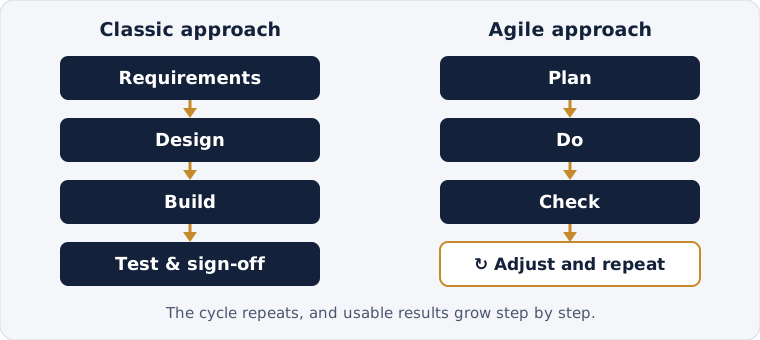
A preparation phase that clarifies risks and delivery capability does not contradict agile principles. It just must not turn into months of detailed planning that rules out later learning.
Eight organizational prerequisites
- Leadership and delegation: Decisions must be possible within clear guardrails, where the work happens.
- Product owner with a mandate: One responsible person must be allowed to make binding decisions on priorities and the product.
- Stable teams: Key people and skills must be reliably available; too much parallel work creates waiting times.
- Open culture: People must be able to raise risks and bad news without blame.
- Product vision and backlog: A clear goal and prioritized requirements give direction.
- Delivery capability: Architecture, integration environments, tests and quality assurance must allow delivery in steps.
- Mutual commitment: Teams take responsibility; leadership protects capacity, priorities and decision paths.
- Measurable learning: Success is measured by product value, quality and delivery capability, not just by meetings or story points.
When agile project management does not work
Fixed price, fixed deadline and fixed scope
A fixed-price contract is not automatically incompatible with agile work. It becomes a problem when the deadline and the full scope are also fixed, even though the requirements are uncertain.
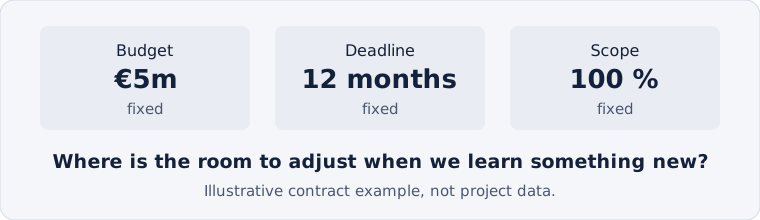
When budget and deadline are fixed, a scope that can be prioritized can help. When the total scope is binding, the contract must settle change mechanisms, reserves and who carries the risk.
Waterfall culture under an agile label
If management demands detailed twelve-month plans, treats every change as a failure and makes decisions only in the steering committee, teams can hardly act adaptively. Sprints alone do not change how an organization is led.
"Agile needs no preparation"
Without architecture guardrails, integration, test data, acceptance criteria and clarified dependencies, technical debt and late surprises follow. Preparation must be based on risk.
Lack of commitment
A sprint is planned, but managers keep adding tasks, pull key people away and still expect the original commitments to hold. What is missing here is not team discipline, but a reliable agreement at the organizational level.
An important distinction: Agile ways of working can still offer some benefits under strong restrictions. But they cannot resolve contractual and organizational contradictions.
Other typical mistakes
For each mistake: cause and countermeasure, in an expandable section.
Product owner without decision-making authority
Several committees change the priorities. Countermeasure: Set the mandate, escalation paths and decision limits in a binding way.
Scrum master without organizational support
Obstacles are identified but not removed. Countermeasure: Leadership must deal with systemic blockers.
Too many parallel projects
Context switching and shared key people slow down delivery. Countermeasure: Limit parallel work and plan capacity transparently.
Daily meetings used as status control
The team reports upward instead of coordinating its work. Countermeasure: Focus the meetings on progress toward the sprint goal and on obstacles.
Story points as a personal performance metric
Estimates become the goal and lose their purpose. Countermeasure: Look at customer value, lead time, quality and predictability.
No definition of done
"Done" means something different to development, testing and the business unit. Countermeasure: Agree on binding quality and completion criteria.
Integration and testing only at the end of the project
Individual teams deliver, but the overall system does not work. Countermeasure: Continuous integration and end-to-end tests.
Ignoring external dependencies
Teams wait for interfaces, approvals and suppliers. Countermeasure: Joint integration planning and clear ownership of each dependency.
Meetings without decisions
Rituals do not replace problem solving. Countermeasure: Review the purpose, participants and outcome of every meeting.
Retrospectives without follow-through
The same problems are discussed again and again. Countermeasure: Prioritize improvements, assign them and track them.
Business units are not available
Feedback and approvals come too late. Countermeasure: Secure business capacity and fixed feedback cycles.
Loyalty to the method instead of business value
Following a framework becomes more important than the result. Countermeasure: Adapt the method to the product, the uncertainty and the organization.
Contracts and supplier structure
In large IT and transformation programs, every team can meet its sprint goals and the program as a whole can still fail: interfaces do not fit, shared test environments are missing, or nobody is responsible for end-to-end delivery.
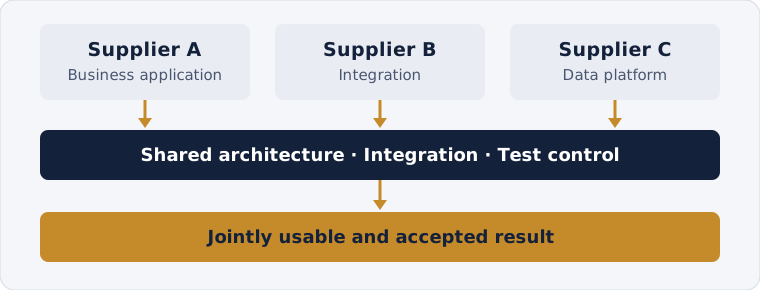
You need common integration milestones, technical ownership of interfaces, aligned test and acceptance plans, transparent dependencies, and a clear escalation and decision structure. The UK guidance on agile contracting covers suitable contract and procurement approaches.
Traditional, agile or hybrid?
| Project situation | Often suitable approach |
|---|---|
| Stable requirements, known solution | Traditional |
| High uncertainty, regular user feedback | Agile |
| Fixed deadline, scope that can be prioritized | Agile or hybrid |
| Fixed price and fully binding scope | Traditional, or hybrid if agreed in the contract |
| Large system integration with several suppliers | Often hybrid |
| Regulatory evidence and fixed acceptance steps | Traditional, or hybrid with iterative delivery |
| Continuous product development | Often agile |
This classification is an editorial decision aid, not a universal rule. A hybrid approach can combine fixed program milestones with iterative development.
Checklist: agile readiness
Check twelve prerequisites for introducing agile. For each question, tick Yes, Partly or No (print it out or use it as a basis for discussion in the team), then count the Yes answers.
| Question | Yes | Partly | No |
|---|---|---|---|
| 1. Leadership Does management support real delegation and decentralized decisions? | |||
| 2. Responsibility Does the Product Owner have the mandate to set priorities that are binding? | |||
| 3. Contracts Do contracts and budget rules allow sensible adjustments? | |||
| 4. Planning Are goals, initial requirements, risks and dependencies sufficiently prepared? | |||
| 5. Capacity Are teams and key people reliably available? | |||
| 6. Culture Can problems be raised early and without blame? | |||
| 7. Business units Are customers and business owners available for regular feedback? | |||
| 8. Architecture Are technical guardrails, interfaces and responsibilities clear? | |||
| 9. Quality Are there binding criteria for done and continuous testing? | |||
| 10. Integration Are dependencies across teams and suppliers managed? | |||
| 11. Steering Does management measure usable results rather than only plan compliance? | |||
| 12. Commitment Do leaders and teams stick to agreed priorities and ways of working? |
Scoring (number of Yes answers):
- 0 to 4 Yes: Key organizational prerequisites should be improved before a broad agile rollout.
- 5 to 8 Yes: Several foundations are in place. Open questions on decisions, capacity and governance should be settled before scaling.
- 9 to 12 Yes: Many important foundations are in place. Now review the specific project, its contracts and its dependencies.
This is a self-assessment, not a scientifically validated maturity test. Individual critical risks can be decisive regardless of the total score.
Introduction in six steps
- Analyse the starting point: Review leadership culture, portfolio, contracts, skills and delivery capability.
- Choose a suitable pilot: Pick an initiative that gains real value from iterative development.
- Define responsibility: Clarify the product owner, architecture, quality and escalation paths.
- Get ready to work: Prepare the product goal, backlog, team capacity, tests and environments.
- Measure the pilot: Track usable results, quality, waiting times and business value.
- Scale with focus: Add more teams and areas only after improvements are proven.
Conclusion: agility is an organisational decision
Agile project management can help with uncertain and complex tasks. It lets you learn earlier and react faster to change. But it does not replace leadership, planning, architecture, quality assurance or contractual clarity.
Provova recommendation: Do not start with Scrum ceremonies. Start with the question of which decisions, capacities, contract terms and quality standards the specific initiative needs.
An organisation that keeps rigid hierarchies, unclear product ownership and conflicting delivery commitments does not become agile through sprints alone.
Sources and context
- Agile Manifesto (2001) – core values.
- Twelve principles of the Agile Manifesto (2001).
- Scrum Guide (2020) – roles, events and artefacts.
- UK Government: Contracting for Agile – contract design.
Editorial status: 27 October 2026. The examples, project assessments and the checklist are explanatory Provova recommendations, not a statistically backed ranking.